A research-informed framework exploring how peer learning environments can cultivate leadership, mentorship, and future educator pathways among underserved high-potential students.

Scalable Peer Flux Leadership (SPFL)

1. theoretical framework introduction

Scalable Peer Flux Leadership (SPFL)
Scalable Peer Flux Leadership (SPFL) is a research-informed youth leadership framework developed by TAFT Foundation. The framework builds on and extends Dr. Sharon M. Ravitch’s Flux Leadership theory and the leadership concepts presented in Leadership Mindsets for Adaptive Change: The Flux 5 into youth leadership development contexts, particularly within peer tutoring, mentoring, and collaborative learning environments.
SPFL is informed by the design and evolution of the TAFT Program, which seeks to create structured peer-learning opportunities where underserved high-potential students can support their peers while developing leadership, mentoring, communication, and collaboration skills.
Through peer tutoring and mentoring, underserved high-potential students develop confidence, leadership identity, and a stronger sense of responsibility toward their learning communities. TAFT recognizes their potential not just as learners, but as active learning leaders and future educators.
By connecting educational practice, reflection, and research, SPFL represents TAFT Foundation’s effort to translate leadership theory into youth-centered learning environments and contribute to broader conversations surrounding educational equity, youth leadership development, and teacher diversity.

2. Theoretical FOundations
Flux Leadership | Flux 5 | Youth Leadership | Peer Learning
SPFL is grounded in Dr. Sharon M. Ravitch’s Flux Leadership theory and the leadership concepts presented in Leadership Mindsets for Adaptive Change: The Flux 5. These perspectives view leadership as a dynamic, relational, and adaptive process rather than a fixed position or formal title.
While Flux Leadership was originally developed to understand leadership in adult and workplace contexts, SPFL extends these ideas into youth development and peer learning environments. The framework explores how leadership may emerge through collaboration, mentorship, shared responsibility, reflection, and reciprocal learning among underserved high-potential students.
SPFL is also informed by research on peer learning, mentoring, youth leadership development, and educational opportunity. Together, these perspectives suggest that students can play meaningful roles not only as learners, but also as contributors to the learning and growth of others.
By bringing these perspectives together, SPFL provides a foundation for understanding how underserved high-potential students may develop leadership identity, mentoring skills, educational agency, and future educator pathways through structured peer-learning experiences.

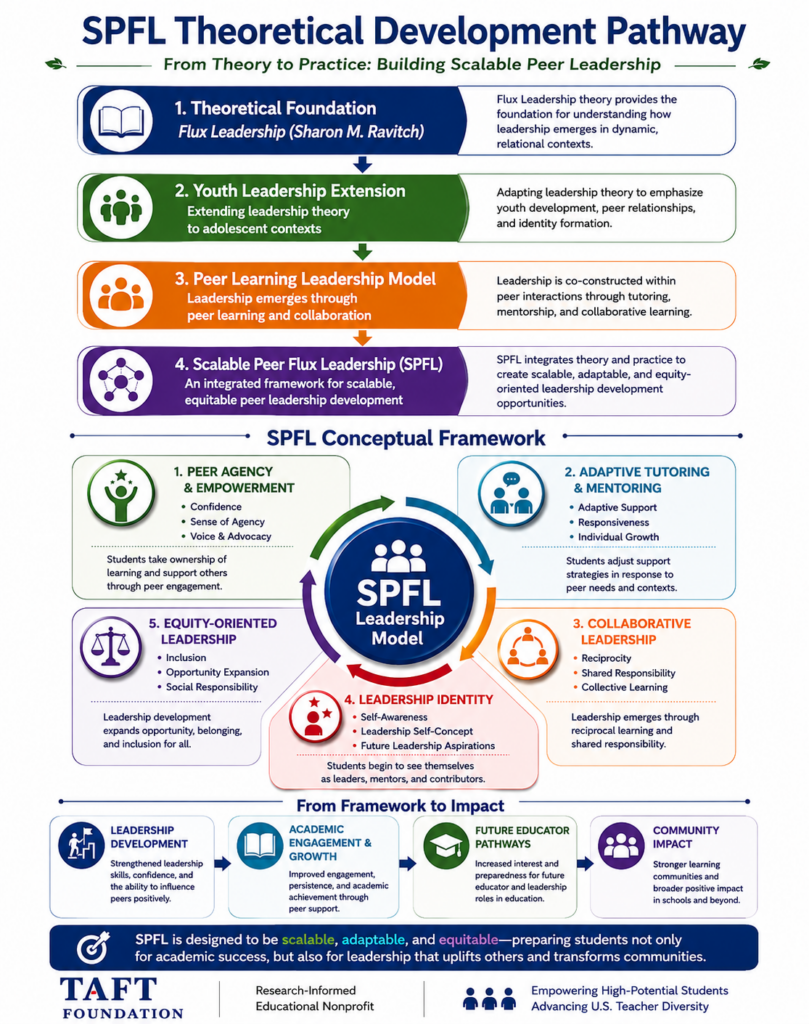
3. SPFL Theoretical Development Pathway
The SPFL framework emerged through the evolution of the TAFT Program and ongoing reflection on peer learning, leadership development, and educational opportunity.
4. Why SPFL Matters
Traditional leadership models were largely developed in adult and organizational settings. SPFL explores how leadership can emerge and develop within peer learning environments among underserved high-potential youth.
SPFL seeks to expand educational opportunity by helping underserved high-potential students develop as peer tutors, learning leaders, mentors, and future educators.
The framework serves as both a research agenda and a practical model for implementing the TAFT Program.


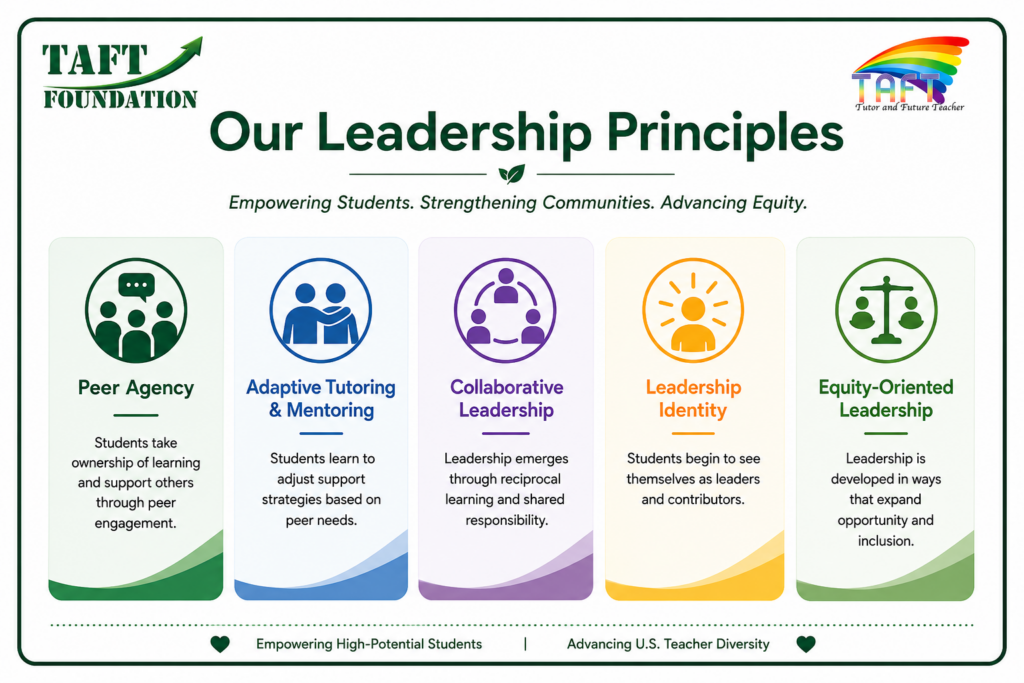
5. Five CORE CONSTRUCTS
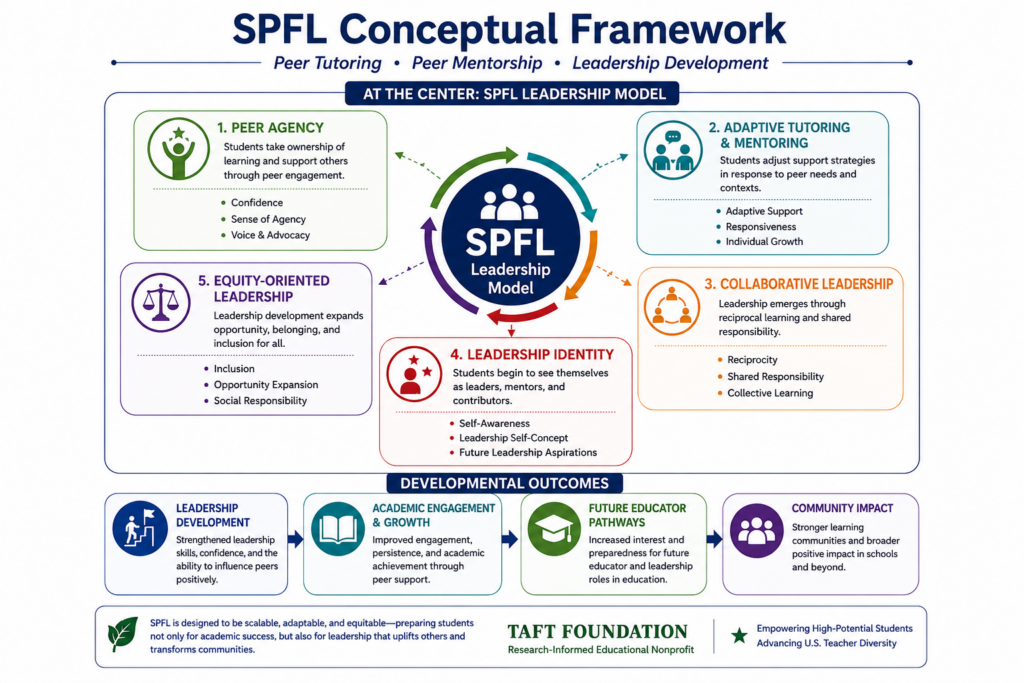
The SPFL framework conceptualizes youth leadership development as an emergent process shaped by structured peer learning environments. Within these environments, several interconnected constructs help explain how students develop leadership capacities while supporting the learning of others.

Tip: Click or tap the image to view it in full size and zoom in.
6. Conceptual Model
SPFL proposes that peer learning environments can become developmental spaces where leadership grows through participation, mentorship, collaboration, and reflection.
In structured peer-learning experiences, students are not only learning academic content. They are also practicing communication, supporting others, taking responsibility, and learning how to respond to real interpersonal challenges. These experiences create opportunities for students to build confidence, develop leadership identity, strengthen mentoring skills, and take greater ownership of their learning.
Through TAFT’s professional training, leadership guidance, peer tutoring, and mentoring experiences, underserved high-potential students can gradually grow as contributors, role models, and learning leaders within their communities. Over time, these experiences may strengthen students’ sense of purpose and open future pathways in education, leadership, and community engagement.
SPFL therefore views leadership not as a fixed position, but as a developmental process that emerges through meaningful relationships, reciprocal learning, active participation, and sustained engagement in supportive peer-learning environments.
7. The Student Journey
Student Participant
Receives academic support, encouragement, and opportunities to build confidence.
Peer Tutor
Begins helping fellow students academically while strengthening communication and responsibility.
Peer Mentor
Provides guidance, encouragement, and support to younger or fellow students.
Learning Leader
Models collaboration, initiative, and positive leadership within peer-learning environments.
Future Educator & Changemaker
Develops a strong leadership identity and a commitment to educational opportunity, community impact, and future educator pathways.

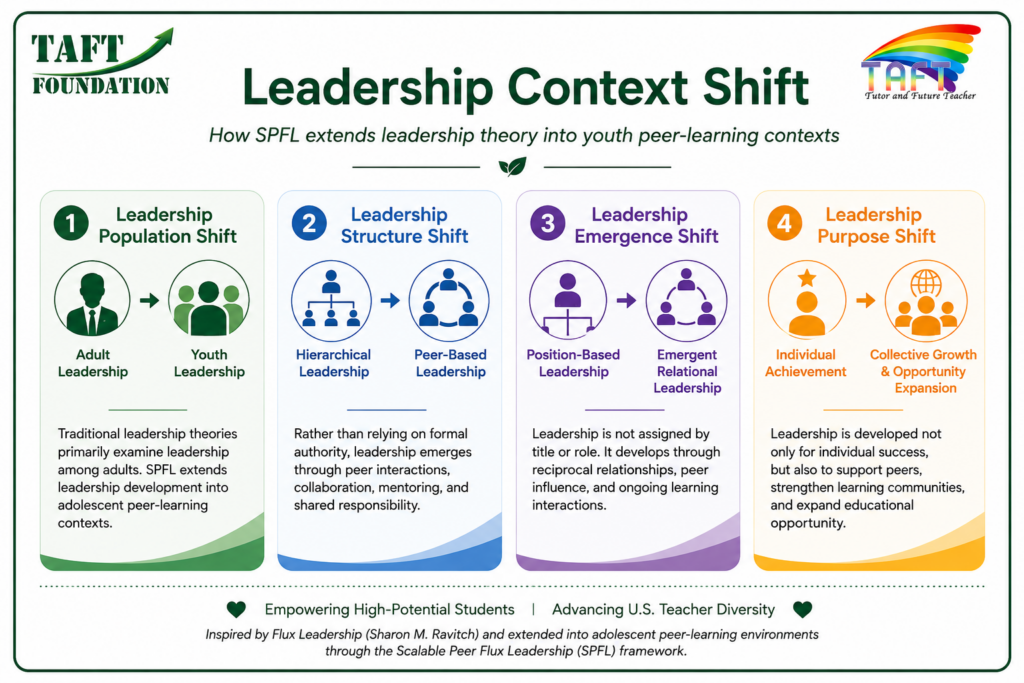
8. Youth Leadership Context Shift
From Traditional Leadership Contexts to Youth Peer Leadership Contexts

9. From Practice to Framework
The TAFT Program provides the practical learning environment in which the ideas behind SPFL can be explored, observed, and refined.
Within the program, underserved high-potential students participate as peer tutors, mentors, and learning leaders. As they support younger or fellow students academically, they also develop communication skills, collaboration skills, confidence, responsibility, and leadership identity through authentic peer-learning experiences.
Many students begin by receiving support, later take on tutoring or mentoring responsibilities, and gradually grow into more active contributors within their learning communities. These developmental experiences help illustrate how leadership can emerge through peer learning rather than through formal leadership positions alone.
The TAFT Program therefore serves as both a student development initiative and a learning laboratory for understanding youth leadership development. Insights gained through program implementation help inform the ongoing refinement of the SPFL framework, while SPFL in turn helps guide future program design, reflection, evaluation, and research.
Together, the TAFT Program and the SPFL framework seek to expand educational opportunity, strengthen youth leadership development, and create future educator pathways for underserved high-potential students.
As TAFT continues to grow, future pilot initiatives and partnerships will help further refine the framework while creating meaningful opportunities for underserved high-potential students.
10. Future Direction
TAFT Foundation continues to refine and expand the SPFL framework through research, reflection, pilot implementation, and collaborative partnerships.
Future work may include:
• Development and validation of SPFL measurement tools
• Pilot studies examining leadership development within peer learning environments
• Research-practice partnerships with schools and community organizations
• Evaluation of future educator pathways among underserved high-potential students
• Development of educational resources, training materials, and practitioner guides
• Contributions to broader conversations surrounding educational equity, youth leadership, and teacher diversity
As the framework evolves, TAFT seeks to connect educational practice and research in ways that generate meaningful opportunities for students, educators, schools, and communities.
As future pilot initiatives and partnerships expand, TAFT will continue refining the SPFL framework while creating meaningful opportunities for underserved high-potential students to develop as tutors, mentors, learning leaders, and future educators.
TAFT Foundation Corp.
8735 DUNWOODY PL STE N,
ATLANTA, GA 30350-2995
United States
Email: info@taftfdn.org
Phone: (678) 2751001